Life Balance Wheel · Part 1
The Wheel of Life: What It Is and How to Fill It In
The wheel of life exercise in 20 minutes: pick your life areas, score each from 0 to 10, draw the wheel and see what to do with the result.

The wheel of life is a circle with eight segments, one for each important area of your life. Score each from 0 to 10, mark the scores on the spokes and join them — the lopsided shape shows at once where things have sagged. What matters most is one line next to each score: why it isn’t one point higher.
Your first wheel takes about twenty minutes. All you need is a sheet of paper and a pen — or our life balance wheel template, which you can fill in right on the page.
The wheel is a tool for reflection, not a test: there’s no solid research behind it as a method, and there are no norms or “right” results.
Where it comes from
The wheel is usually credited to Paul J. Meyer, founder of the Success Motivation Institute. Meyer founded the institute in 1960, but that’s the year of the institute, not of the wheel: when the wheel itself first appeared isn’t reliably known. Today the exercise is popular in coaching. Wheel of Life is a registered US trademark of its owner.
It has nothing to do with the Buddhist wheel of life (the bhavachakra) apart from the name.
What you’ll need
- 20 minutes without your phone. Turn notifications off: the wheel needs honesty, and honesty is easy to lose between two messages.
- A sheet of paper. Draw a circle about the size of your palm and draw four lines through the centre — that gives you eight spokes, like a wheel. The centre is 0, the rim is 10. A ready-made printable blank is in the template.
- A pen, ideally two colours. The second colour is for a “where I want to be” layer — optional, more on it below.
Step 1. Pick your areas
This list of eight is a fine place to start: health, work and career, money, family and partner, friends and community, personal growth, fun and hobbies, home and surroundings.
It’s an example, not a canon: the wheel has no single standard list. If an area isn’t about you, swap it; if something important is missing, add it. How to build your own list and what goes into each area is part two: wheel of life categories.
Write the areas at the ends of the spokes, one per spoke.
Step 2. Score each area from 0 to 10
The scale is simple:
- 0 — this area doesn’t work for you at all;
- 10 — there’s nothing you’d want to change.
Score how things have been over the last month, not “on average across my life” and not “how it’ll be after my holiday”. The wheel is a snapshot, not a biography.
Write down the first number that comes to mind and don’t haggle with yourself. Then, right next to it, add one line: why it isn’t one point higher. For example: “Health — 5: sleeping six hours a night, haven’t exercised since March.” That line is worth more than the number: in a week you’ll forget the number, but the reason tells you where to start.
0–10 or 1–10 makes no difference. What matters is that once you’ve picked a scale, you keep it from one wheel to the next — otherwise you can’t compare them.
Step 3. Draw the wheel
- Mark each score as a dot on its spoke: 5 halfway out, 8 close to the rim.
- Join the dots all the way round.
- Shade in the shape.
Here’s what it might look like. Anya is a composite example: an analyst with a lot of work and little time for herself.
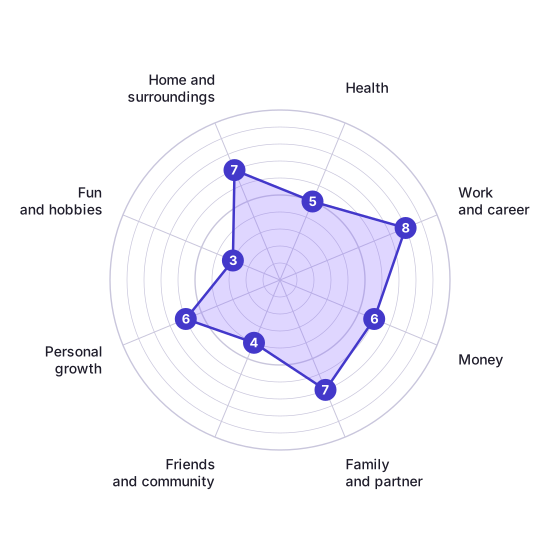
The shape says more than the list of numbers: work stretches out towards the rim, while fun and friends have sunk towards the centre. Next to her 3, Anya has written: “Weekends go on chores and sleep; no hobbies since spring.”
A second layer, if you like. In another colour, mark on each spoke where you’d like to be, and join those dots too. That’s how Mindtools suggests doing it: first “now”, then “where I want to be”, then look at the gap. The target isn’t always 10: some people are happy with a 7 for career because other things matter more.
Common mistakes
- Scoring through someone else’s eyes. “At my age, money should be an 8” isn’t your score. Put down what you actually feel.
- Giving everything a 5 or 6 to avoid thinking. That wheel is smooth and says nothing. If everything is “fine”, ask yourself which area you’d change first — it’s not really a 6.
- Stretching it over an evening. The longer you deliberate, the more the score becomes “how it should be” rather than “how it is”. Twenty minutes is enough.
- Filling it in on a bad day and drawing conclusions for the year. After a hard week the wheel will look bleaker than your life. That’s normal, but before making decisions, check it again with a fresh head.
- Comparing your wheel with someone else’s. Other people have other areas, other 10s and a different scale in their heads. The only useful comparison is between your own wheels.
What next
A filled-in wheel is a starting point, not a result. It shows where things feel off, but it doesn’t tell you what to do. The one rule for now: don’t try to fix everything at once. Pick one area, two at most, that hold you back the most — the rest can wait. How to read the shape of the wheel and what to choose is part three: how to read your wheel of life and decide what to change.
But first, check the areas themselves. If, while filling it in, you found the starter eight don’t fit you, or your scores felt like guesswork, the next step is to build your own list and define a 10 for each area. That’s part two: wheel of life categories.