Life Balance Wheel · Part 3
How to Read Your Wheel of Life and Decide What to Change
Your wheel is done, now what? How to read its shape, why a perfect circle is not the goal, and how to pick the one or two areas to start with.

Don’t look for the lowest area — look for one where a low score meets something you actually want to change now, and pick one or two, no more. Look at the shape of the wheel and at the “why” lines next to the scores first: they say more than the numbers.
If you haven’t filled in a wheel yet, start with the part on what it is and how to fill it in. This part is about reading it.
First, look at the shape
Step back from the numbers and look at the wheel as a whole. Three things stand out:
- Dips — one or two segments clearly lower than their neighbours.
- Spikes — the wheel jumps up and down: eight, three, seven, four.
- Overall level — whether the wheel is large or small as a whole.
A small even wheel (fours across the board) and a large lopsided one (eights with a single two) tell different stories. The first usually means everything is hard at once, and the place to start is one simple step that makes the day lighter. The second means life is broadly in order and one area is sagging — worth thinking about on its own.
The shape is a prompt for questions, not a diagnosis. The wheel is a tool for reflection, not a psychological test: it has never been validated as a method, and there are no norms or “correct” values. A perfect circle is not the goal. A wheel of straight eights from someone in the middle of a deadline crunch more likely means the scores were rushed.
A worked example
Take a composite example: a developer whose child was born a year ago. Their wheel shows “how it is now” scores and, as dots, how important it is to change each area now (more on that second column below):
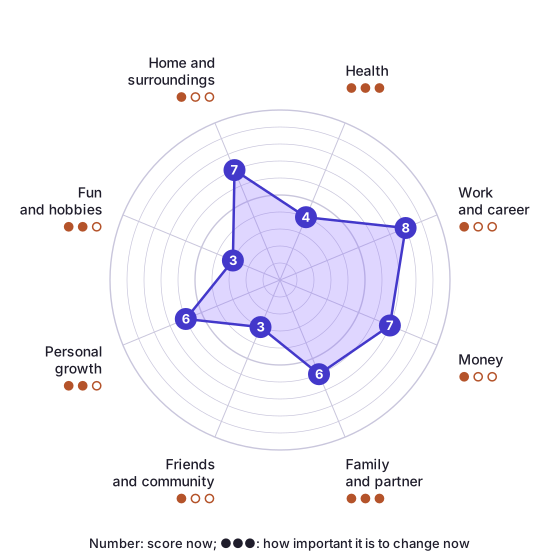
| Area | Score | Want to change now (1–3) |
|---|---|---|
| Health | 4 | 3 |
| Work and career | 8 | 1 |
| Money | 7 | 1 |
| Family and partner | 6 | 3 |
| Friends and community | 3 | 1 |
| Personal growth | 6 | 2 |
| Fun and hobbies | 3 | 2 |
| Home and surroundings | 7 | 1 |
What you can see. Work, money and home are high — that part of life is holding up. The dip is friends, fun and health. The wheel is lopsided, but not small.
What’s behind the numbers. The most useful part of a wheel is the short note next to each score: “why not one point higher”. For health: “sleeping five hours, quit the gym”. For fun: “no energy in the evening for anything but my phone”. For friends: “not seeing anyone, but I don’t really miss it right now”. For family: “my partner and I only talk about the baby”.
What gets picked. Health is low and important. It also pulls fun and family along with it: lack of sleep eats the evening. The second area is family — not the lowest, but it hurts. Friends score lowest, but “I don’t miss it right now” is an honest answer: putting it in the plan means taking on a commitment they don’t want. In six months the answer may be different.
Score and importance
A single “how it is now” score doesn’t tell you what to do. Add a second column: how important it is to change this area now — from 1 to 3, or from 0 to 10. To compare honestly, it helps to have written down what a 10 means to you in each area — that’s covered in the part on life areas.
Then a simple grid:
| Important to change | Not important now | |
|---|---|---|
| Low score | candidates for the plan | honestly leave as is |
| High score | protect it, don’t trade it for something new | leave alone |
There’s another option. Mindtools suggests marking an ideal level on each axis after your current scores, then looking at the gap between “now” and “want”. It works well when you don’t need a 10: in money a 7 may be plenty, and then there’s no gap. You can draw this second “want” layer on the same sheet in another colour, or switch it on in the life balance wheel template, where it’s drawn as a dashed line over your current scores.
Neither is a method with proven power. Both are just ways to separate “it’s bad here” from “I want to change this”.
The lever area
Ask yourself: a change in which area would move two others? Often it isn’t the lowest one but the one connected to the rest. Sleep pulls health, work and family. Money pulls home and fun. Time for yourself pulls fun and growth.
This is a question to ask yourself, not a law: your connections may be different, and a low area doesn’t have to drag the others down. But if one of your candidates touches two or three more, it makes a good first pick.
One or two areas, not five
Attention and time are limited. Five areas “to improve” at once means five new commitments on top of the ones you already have, and a month later there’s usually none left. One or two areas means a few hours a week — and those can be found.
For each area you pick, write one sentence: what will be different in three months. Not “health goes up to 6”, but “I sleep seven hours on weeknights”. Turning that sentence into a goal, a weekly action and a slot in your calendar is the next part, from the wheel to goals.
When the numbers say more
If you’ve been scoring health, sleep or mood low for several weeks in a row, that’s a reason to talk to a doctor or a psychologist, not to redraw the wheel. The wheel helps sort out your thoughts, but it doesn’t diagnose anything and doesn’t replace a professional.
What not to do
- Compare with other people’s wheels. Everyone has their own areas and their own 10; your 7 and someone else’s are different numbers.
- Conclude “everything is bad” from one wheel. A wheel reflects the week you drew it in. A bad week makes a low wheel.
- Fix everything at once. That’s the same list of eight goals, just drawn as a circle.
- Average the scores. The mean of a wheel is not a “happiness index” or a measure of wellbeing: the method has no scales or norms, and the areas can’t be compared with each other.
What’s next
You have one or two areas and a sentence about what will be different in three months. The next step is to turn it into a goal for the quarter and one action a week with a place in your calendar. That’s the last part of the series: from the wheel of life to goals.